Reflections and lessons from two years as a Walmart Spark delivery driver
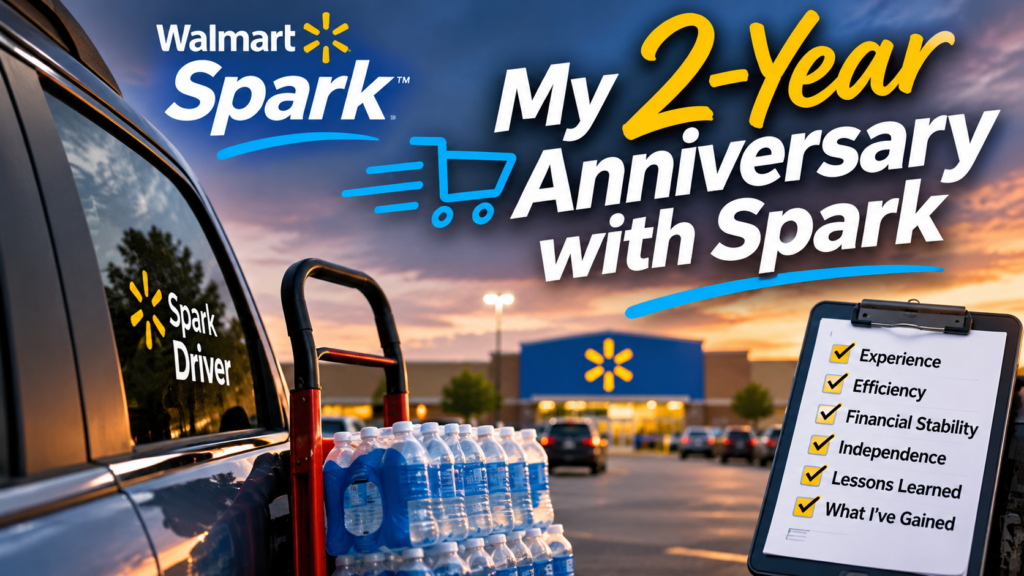
On November 14, 2024, I began delivering for Walmart Spark. Two years later, I’ve learned that being successful in gig work involves much more than accepting orders, shopping for groceries, and making deliveries.
It’s about developing good judgment, understanding the value of your time, treating people with respect, and knowing when enough is enough.
Looking back on my second anniversary, I’m proud of what I’ve accomplished. One milestone was my highest-grossing week, October 26 through November 1, 2026, when I earned $1,742.05. That was an exceptional week for me, not a promise of what every driver can expect.
I’m grateful for those accomplishments, but there’s something I want to make clear before discussing anything else.
I’m performing at my pace. That doesn’t necessarily mean it’s the pace another driver should try to achieve.
1. Find Your Own Pace and Define Your Own Success
Before Spark, I’d already spent years in gig work, including driving passengers for Uber and Lyft and shopping orders through DoorDash. But starting Spark on November 14, 2024, was another experience entirely. I was lost. Nobody showed me how or where to find everything, and the process was nothing like what I’d been doing with DoorDash. I was ready to move on from DoorDash and make money, but I had plenty to learn.
I wouldn’t be the driver I am today without those awkward first days. They taught me to figure things out, ask questions when necessary, and keep improving instead of expecting everything to make sense immediately.
One of the most important things I would tell any new gig driver is to set yourself up to succeed.
Determine what hours you want to work, what kinds of orders you’re comfortable accepting, and what financial goals make sense for your circumstances.
Some drivers prefer shopping orders. Others prefer curbside pickups. Some work mornings, while others work evenings or weekends. There’s no single schedule or strategy that fits everybody.
My personal goals are to earn at least $100 in trip pay and $150 in total daily earnings. Those are goals I’ve established for myself based on my own circumstances and experience.
Success should be measured against what you’re trying to accomplish, not against what another driver posts online.
For me, the biggest accomplishment hasn’t been a particular day’s or week’s earnings. It’s becoming financially stable. I’ve never been someone who spends a lot just for the sake of spending, but there were times when buying something I wanted left me wondering whether I’d make enough before the next bill came due. Spark has helped me reach a point where that worry doesn’t hang over every decision. I enjoy opening my account after working and seeing money there that wasn’t there when I started the day.
There was a time when I worked as a church custodian and drove for Spark after finishing my responsibilities there. Eventually, I made the decision to leave that position and make Spark my full-time work. It wasn’t simply about a paycheck; I needed a change, and Spark offered an opportunity to earn more. I was already familiar with the nature of gig work, so the unpredictability didn’t frighten me. If you clock out early from a regular job, you don’t get paid for the hours you didn’t work. Gig work has another layer because you aren’t earning while waiting between orders, but I understood the tradeoff.
That change also made me pay closer attention to how much profit I could produce with my time. I gradually learned that staying busy and making good money aren’t necessarily the same thing.
And for those drivers who have families, I want to emphasize something above everything else:
Don’t sacrifice time with your family just to keep driving for Spark, DoorDash, Instacart, or any other gig platform.
At the end of the day, it’s a job. Your family deserves your time, too.
2. Find a Mentor and Be Willing to Learn
If you’re new to gig work, find someone who has experience doing what you’re trying to do.
Find another driver who isn’t afraid to share what they’ve learned, answer questions, and help you avoid some of the mistakes they’ve made.
Unfortunately, not every driver is willing to communicate or share information. Some prefer to keep everything they’ve learned to themselves.
I see things differently.
There’s enough to learn in this line of work that having someone willing to offer guidance can make a tremendous difference.
And when you’ve gained experience yourself, consider becoming that person for somebody else.
I’ve had the opportunity to help other drivers, and I’ve learned that mentoring isn’t always easy. Sometimes you’re having a good day while someone you’ve tried to help is struggling. You can share what works for you, listen, and offer encouragement, but you can’t control which offers another driver receives or the decisions they make. The goal of mentorship isn’t to produce a copy of yourself. It’s to help someone develop the judgment and confidence to make good decisions independently.
You don’t have to reveal every detail of your earnings or personal business to be helpful. Sometimes a little practical advice or a few minutes of conversation can make another driver’s day much easier.
3. Learn from YouTube, but Be Selective
New drivers can find a lot of useful information on YouTube. Some creators share practical demonstrations, explain how they evaluate orders, talk about the costs of driving, and offer thoughtful advice based on their experiences. Those videos can help you learn before you’ve encountered every situation yourself.
But be selective about what you watch. There’s also plenty of complaining, unnecessary commentary, and advice that makes it sound as though everybody can earn the same amount by following one particular strategy.
Markets and expenses vary, so even genuine results from a creator may not translate to your situation.
Listen to people who explain why they do things, not just how much money they made. Compare perspectives, take what is useful, and test it against your own experience. Use YouTube as a learning resource, not a one-size-fits-all instruction manual.
4. Start Slowly, Then Build Your Efficiency
With Spark onboarding new drivers, I would encourage those just getting started not to get in too much of a hurry.
Take time to learn how the app works, how the stores are organized, and what to expect during shopping, checkout, loading, and delivery.
That doesn’t mean ignoring delivery expectations or taking longer than necessary. Spark provides estimated completion times, and drivers should work responsibly within those expectations.
But efficiency comes with experience.
When I was new, I accepted nearly everything Spark offered. I was learning the process, but I wasn’t always using my time well. Once Spark became my full-time work, I gradually began evaluating orders with profitability in mind. Shopping faster helped, yet learning to recognize which offers were worth accepting made an equally important difference.
These days, associates sometimes tell me I’m one of the hardest-working people they know because they always see me coming and going. But I’m not necessarily pushing myself harder on purpose. I’ve become more efficient. And between orders, I’m just as likely to be scrolling Facebook or watching some unrelated video as I am to be thinking about groceries. Experience helps me accomplish more without having to reinvent the process on every trip.
The more familiar you become with the process, the easier it becomes to move confidently from one step to the next.
Here’s how I look at it:
The faster you can accept an order, shop it accurately, check out, load your vehicle, and complete the delivery, the sooner you become available for another opportunity.
Those minutes add up throughout a working day.
But speed should never come at the expense of accuracy, customer service, or safety.
5. Shop Every Order as Though It Were Your Own
Approach every order as if you were shopping for yourself. Whether it’s two items or sixty, I want the customer to receive the correct merchandise, sensible substitutions when needed, and purchases handled with care. A difficult or bulky order shouldn’t receive less attention than a simple one.
Sometimes that attention comes down to something as ordinary as a carton of eggs. On a recent shopping trip, I checked the eggs and found broken ones in more than one carton. I took the time to make sure the customer received intact eggs rather than simply scanning the first carton I picked up. Checking fragile groceries is a small step, but it matters to the person unpacking them at home. Whenever possible, I prefer to find a complete, undamaged carton with its original labeling intact.
That same care applies at delivery. On November 10, I shopped an Express order that included a video game. Before the customer came to the door, I sent a message and a picture explaining that I intended to place the delivery on the rocking chair closest to the entrance, tucked behind a pillow so it wouldn’t be plainly visible to passersby. The customer then answered the door, and I completed the delivery with the required photographic confirmation. It wasn’t an elaborate gesture. I was simply thinking about how I’d want my own purchase handled.
Good service isn’t just finding the right item and reaching the right address. It’s noticing the little things that protect the customer’s purchase and give them confidence in the delivery.
6. Respect the Store Associates
When I started driving for Spark, there was something on almost every shopping order I couldn’t find. Sometimes I was looking in the right aisle, but the product was actually on a display somewhere else. Asking associates for help wasn’t always comfortable for me. I’m naturally a private person, and outside work I generally keep to myself. But finding the merchandise was part of my job, so I asked when I needed to. Not everyone was helpful, and that could be aggravating, but those encounters were part of learning. I discovered the value of becoming familiar with store layouts and treating the people working there with respect.
That respect needs to go both ways. Some associates don’t particularly like Spark drivers, perhaps because of past interactions, misunderstandings, or resentment about what drivers might earn. Some drivers, in turn, get impatient with associates. Neither attitude helps anyone do their job.
After enough shopping trips, I’ve become so familiar with store layouts that I can remember where a surprising number of products are supposed to be, from grocery aisles to refrigerated displays and general merchandise. That knowledge didn’t come overnight. It came from shopping orders, asking questions, paying attention, and learning one trip at a time.
Of course, knowing where something should be doesn’t mean it’s actually there. Sometimes merchandise seems to have taken a vacation from its assigned shelf and turned up on a promotional display somewhere else. The app doesn’t always reveal alternate locations immediately. Sometimes it suggests another location only after the driver reports the regular shelf empty; sometimes the alternate display isn’t entered into the system at all.
That’s why it’s worth checking nearby displays and politely asking for help before assuming an item is unavailable. The associate you ask may not be the person who stocked it or entered the alternate location, either.
Shopping at different types of stores has shown me that checkout procedures and operations can differ considerably. I’ve encountered self-checkouts set aside for Spark drivers and associates who found practical ways to help a driver complete checkout. Experiences like those have made me appreciate solutions that help drivers work efficiently without inconveniencing other shoppers. They have also reminded me that we’re shopping on behalf of customers, and their orders deserve the same care and consideration.
Because drivers and associates may cross paths repeatedly, those relationships matter. Be courteous and remember they’re doing their jobs, too. You don’t have to be particularly outgoing to provide good service. I’m friendly with customers, but I’m usually there to unload their order, make sure it’s handled properly, and wish them a good day or evening.
Sometimes customers place Express orders and expect their merchandise to be available immediately. But just because an item appears in the app doesn’t mean an associate can magically materialize it on the shelf.
If something isn’t available, it isn’t necessarily anybody’s fault.
When an associate takes time to help locate merchandise, check inventory, or retrieve something from another area, show your appreciation.
Two simple words can go a long way:
Thank you.
Respect shouldn’t depend on whether somebody can solve your problem. It’s something we should extend to people because they’re people.
7. Be Patient and Selective About Your Orders
Gig work has good days and bad days.
There will be days when almost every offer that appears on your screen looks attractive. You may receive one good shopping order after another, or several pickup orders that fit exactly what you’re looking for.
Then there will be days when it seems like the platform is offering nothing but orders that simply aren’t worth your time.
That’s part of the business.
Be patient. Be selective.
Don’t feel obligated to accept an order merely because it appears on your screen.
Develop your own standards for determining whether an offer is worthwhile, and understand why those standards matter.
Those standards should reflect your market, not just your preferences. I’ve tried working in smaller markets where orders were infrequent and waiting for the next offer could take a long time. I’ve also worked stores where many deliveries were long hauls into areas far from another practical pickup or shopping opportunity. A payout that looks good at first glance can become much less attractive when you account for the unpaid drive back, the wait for another offer, and whether you can reach the next store in time to start a new trip without affecting your metrics.
Some markets offer more opportunities to be selective than others. I wouldn’t assume my approach would work the same way everywhere. Learn your own area: how often offers arrive, where deliveries tend to take you, and what happens after you complete one. A profitable order should be considered in the context of the entire working day.
Why I Gradually Moved Away From Pickups and Returns
When I started driving for Spark in November 2024, I accepted both shopping orders and curbside pickups. I even tried a few returns. It wasn’t until I’d gained some experience that I gradually began favoring shopping orders. That decision wasn’t based on one frustrating afternoon. It came from repeatedly seeing how much of my time could disappear while waiting on something outside my control.
With some curbside offers, I’ve arrived at a store and had to wait 20 or 30 minutes before the app would even allow me to start the trip. After checking in and selecting a parking spot, I might wait another 10, 15, or 20 minutes for the order to come out. Sometimes the order wasn’t even finished being picked, much less staged and ready to dispense, when I arrived.
At some stores, I’ve watched drivers arrive after me, get loaded, and leave while I was still waiting. I’ve also checked in, waited as long as 20 minutes, and then had the store cancel the order. On occasions, that same order appeared as an available offer again just five minutes later. I’ve wondered whether performance metrics played a part in those cancellations, but I can’t verify why they happened. What I can say is that I spent time waiting and ended up without the delivery I’d accepted.
Returns could be just as frustrating. I’d pick up an item from a customer, drive it back to the store, and then wait another 10, 15, or 20 minutes for an associate to retrieve it. Until that happened, I couldn’t finish the return and move on to another offer.
RETURNS ARE NOT WORTH IT! That’s been my experience, at least.
Shopping orders aren’t perfect, but they give me more control. I can select the merchandise carefully, protect fragile groceries, organize the order, and move toward delivery as soon as I’m done. These days, I generally choose shopping orders, although I’ll occasionally make an exception when an offer makes sense.
Here’s the lesson for someone starting out: don’t judge an offer by the amount displayed on the screen alone. Consider how long it may actually take, what you’ve experienced at that store, and how much of the process you can control. Your time has value, even when you’re sitting still.
8. Understand What It Really Costs to Drive
One of the easiest mistakes to make in gig work is looking only at the amount displayed on an offer.
That number isn’t necessarily what you’re putting in your pocket.
You have expenses.
Fuel costs money. Tires wear out. Oil changes, maintenance, repairs, and vehicle depreciation all matter.
Your time matters, too.
And something that drivers sometimes overlook is their own health.
Long days, irregular meals, fatigue, and the physical demands of shopping, loading, and unloading can take their toll.
If you’re going to approach gig work seriously, you need to understand what it costs you financially and personally.
Gross earnings tell you what you brought in. They don’t tell you everything about what it took to earn it.
9. Know Your Limits and Recognize When to Stop
One of the things I appreciate about Spark is the degree of independence it gives me. It’s not complete independence: the platform sets the rules, tracks the work, and controls the offers. But within that system, I can make choices about when I work and which orders I take. I like being able to do the job on my own terms.
I do wish the app itself were simpler and more reliable. Sometimes a new feature that seems helpful just adds clutter, and getting through automated support to a person who can actually resolve an issue can be frustrating. Drivers need tools that work and help when something goes wrong, not extra obstacles between them and the job.
There may be days when everything goes right.
The offers are good, the stores aren’t crowded, the merchandise is available, and the deliveries go smoothly.
Enjoy those days.
There will also be days when nothing seems to go according to plan.
You might encounter long checkout lines, missing merchandise, difficult deliveries, app problems, or simply a string of disappointing offers.
Sometimes you can push through those frustrations and turn the day around.
Other times, the better decision is to stop.
Know your limits.
If you’re tired, frustrated, or simply having a day when things aren’t going well, remember that you have a choice.
You can continue working if you’re able to do so safely and responsibly, or you can call it a day.
There’s no shame in deciding you’ve done enough.
The opportunity to work another day is worth more than forcing yourself to keep going when you shouldn’t.
10. Two Years of Experience, and Still Learning
Two years haven’t taught me everything there is to know about Spark. They’ve taught me to ask better questions before accepting an offer, and to remember that being busy is not the same as being productive.
I’m proud of the milestones I’ve reached, especially the financial stability that came from learning how to make this work for me. But I don’t believe every driver needs to pursue the same numbers. My results reflect my circumstances, my choices, and the pace I’ve established for myself. Another driver may find greater satisfaction working fewer hours, spending more time at home, or accepting entirely different types of orders. That driver may be just as successful.
At the end of the day, remember that this is just a job. It can be as stressful as you make it, just like any other job.
You’re going to encounter difficult customers. You’re going to receive bad ratings that seem to come out of nowhere. And there will be times when you’re standing in front of ten cases of water, wondering why in the world you accepted that order.
But you’ll remember those experiences. You’ll learn from them, and next time you’ll know what you’re getting yourself into.
As for me? I’ll take those ten cases of water again, provided I’ve got my dolly and the offer pays enough to make it worth my time!
Two years ago, I started Spark without knowing what I was doing. Today, I’ve found my own pace, learned to value my time, and reached a level of financial stability that once seemed difficult to achieve. I didn’t get here by doing everything perfectly. I got here by showing up, learning from my mistakes, and figuring out what works for me.
Find your own pace. Learn from your experiences. Treat customers and store associates with respect. Don’t measure your success against somebody else’s earnings, and don’t forget that there’s more to life than the next delivery.
Make the job work for you, rather than allowing the job to run your life.
That’s my two cents.
Reader Discussion
Join the conversation.